Can You Really See the Northern Lights with Your Own Eyes?
The Northern Lights are one of the most fascinating natural phenomena on Earth. While you can increase your chances of seeing them, it is never possible to guarantee when or how they will appear. That unpredictability is part of their magic.
The Northern Lights are one of the defining experiences of a trip to Lapland. For us at FREKE, they are the closest thing to magic that can be experienced on Earth.
At the same time, few natural phenomena spark as much discussion on social media. Can you really see the Northern Lights with the naked eye or not? And why do they often appear much more vivid in photographs than they do in real life?
Michelle spent many years guiding Northern Lights tours in Abisko, Sweden. Her fascination with this spectacular display in the night sky has never faded. In this article, she answers some of the questions she was asked most frequently.
How Can I Make Sure I See the Northern Lights During My Trip?
The honest answer is: you can't.
There is no guarantee that you will see the Northern Lights during your trip. All you can do is increase your chances. Auroras can only be predicted to a limited extent – and certainly not weeks or months in advance.
Years in Advance
If you are planning well ahead, you can use the approximately 11-year solar cycle as a rough guide. The chances of seeing the Northern Lights are generally higher during the so-called solar maximum, when the Sun is particularly active. During this phase, there are more sunspots and stronger solar eruptions, increasing the likelihood of impressive auroral displays.
However, it is not always possible to determine exactly when the solar maximum begins or ends. According to official information from NASA and NOAA, the current solar maximum started in autumn 2024 and is expected to continue until around 2026. This does not mean that you will no longer be able to see the Northern Lights afterward. Even during the solar minimum, which is expected in roughly ten years, auroras can still be observed—just less frequently and usually not as far south as Central Europe.
Days in Advance
Never rely on apps that claim to predict the Northern Lights more than three days ahead.
Solar eruptions typically take between one and three days to reach Earth. As a result, a seven-day aurora forecast is often based on events that have not even occurred on the Sun yet.
Forecasts become significantly more reliable only after a solar eruption has actually been observed and its potential impact on Earth can be calculated. For this reason, KP index predictions far into the future should always be treated with caution.
30 Minutes to One Hour in Advance
In my opinion, websites such as SpaceWeatherLive provide the only truly reliable short-term aurora forecasts. Their data comes directly from satellites that monitor the solar wind traveling between the Sun and Earth.
There is usually only a 30- to 60-minute delay between the measurement of the solar wind and the arrival of those charged particles in Earth's atmosphere. This gives you a very good indication of what aurora conditions may look like during the next hour.
The challenge, however, is learning how to read the data correctly. It requires some research and practice. Those who take the time to understand it are often rewarded with much more accurate predictions than any standard Northern Lights app can provide.
The Most Important Tip
If you want to see the Northern Lights, keep it as simple as possible: check the webcams in your area. They are often more reliable than any forecast when it comes to showing what is actually happening in the sky right now. If a nearby webcam is capturing the Northern Lights, there is a good chance that you will be able to see them from your accommodation as well.
The most important factor is often not the KP index, but the weather. Especially in Lapland, even the strongest aurora display is of little use if the sky is hidden behind a thick layer of clouds.
Or, to put it another way: nobody gets excited about green clouds.
If the forecast shows dense cloud cover throughout the night, you can safely turn off your alarm and catch up on some sleep instead.
When Can You See the Northern Lights?
The most important requirement is darkness.
During the polar night, it can already be dark enough to see the Northern Lights as early as 2:30 p.m. in some parts of Lapland. In spring, on the other hand, true darkness may not arrive until around midnight.
Auroras occur regardless of our local time, but they are only visible to us when the sky is sufficiently dark. That is why it is worth checking the lunar phases when planning your trip, especially if seeing the Northern Lights is high on your bucket list.
Even during a full moon, the Northern Lights can be observed and photographed beautifully. In fact, the resulting images can look particularly surreal, as the snowy landscape is illuminated by moonlight. At the same time, however, the contrast between the aurora and the sky is reduced. On clear nights with a full moon, the snow often reflects so much light that you can comfortably walk around without a flashlight.
How long the Northern Lights remain visible is much harder to predict. Sometimes they dance across the sky for hours, accompanying you throughout the night. On other evenings, you may wait patiently for several hours only to be rewarded with a spectacular display lasting just a few minutes.
That is exactly what makes the Northern Lights so special: despite all our technology and forecasting tools, they always retain an element of unpredictability.
Where Is the Best Place to See the Northern Lights?
The so-called sweet spot for viewing the Northern Lights lies roughly between 60° and 75° latitude. In fact, it is possible to be too far north to experience the best aurora displays.
This is because the auroral oval resembles a ring rather than a solid area. If you are located farther south, you will usually look north to see the Northern Lights. In places like Svalbard, however, it is not uncommon to look south instead.
I spent many years in Abisko, Sweden. There, the Northern Lights can often be seen in every direction because the auroral oval frequently sits directly above the area. Some of my favorite moments are the nights when the aurora seems to rain down from the sky. You lie in the snow and watch as waves of light explode overhead—almost like a firework display in slow motion.
When choosing a destination for an aurora trip, however, you should consider more than just latitude. The number of clear nights is at least as important.
Abisko has earned a special reputation among aurora enthusiasts because it experiences an unusually high number of cloud-free nights. Located in the rain shadow of the Scandinavian Mountains, the area receives relatively little precipitation and snowfall. As a result, the chances of clear skies are significantly higher.
Another extremely popular destination is Rovaniemi. Winters there, however, tend to be cloudier. For this reason, many tour operators offer so-called Northern Lights chases. These excursions leave the city in search of the best weather conditions and clear skies.
Sometimes that means only a short drive. Other times, the search for clear skies can even take you across the border into Sweden.
How Fast Do the Northern Lights Move?
In the past, this question was difficult to answer. Today, smartphones and modern cameras are powerful enough that almost anyone can record videos of the Northern Lights themselves.
However, there is no single answer to how fast auroras move. Sometimes they appear almost motionless. I have experienced nights where the Northern Lights stayed frozen in the sky for hours, barely changing their shape.
More often, however, they move in waves. They intensify, fade again, sometimes disappear completely—only to reappear shortly afterward. This constant change is a big part of their fascination.
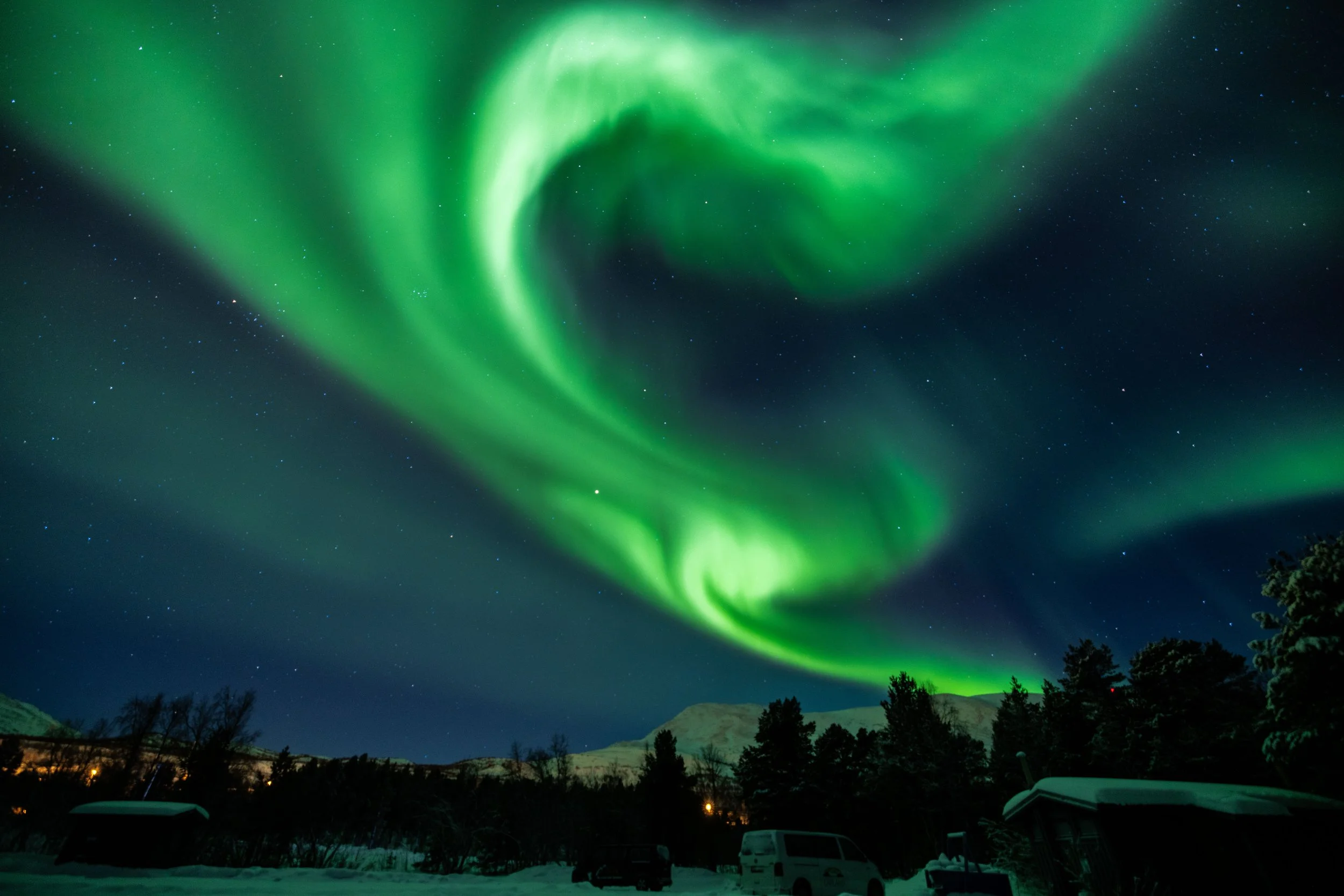
The most impressive displays are the so-called “dancing Northern Lights.” In these moments, shapes and structures shift within seconds. Bands of light snake across the sky, rays shoot upward, and entire curtains seem to come alive. During their most active phases, auroras can move surprisingly fast—so fast that even modern cameras sometimes struggle to capture the motion realistically. The fastest Northern Lights I have observed moved across the sky almost like shooting stars.
The most spectacular auroras I have ever witnessed were usually the ones with the most intense colors, the highest contrast, and the fastest movement. At the same time, these moments are often very short-lived. A sky that seemed calm just minutes earlier can suddenly erupt and return to calm just as quickly.
That is why aurora hunting always requires patience. Those who want to experience truly exceptional nights often spend hours outside in the cold—camera on a tripod, eyes fixed on the sky, ready for the moment when an ordinary night turns into the night of nights.
Social Media vs. Reality
Cameras almost always capture the Northern Lights differently than the human eye.
The main reason for this is exposure time. While a camera can collect light over several seconds, our eyes process the world in real time. As a result, cameras capture significantly more light and color than we are able to perceive visually.
This is why the Northern Lights often appear more intense, more contrasted, and more colorful in photos than they do in reality. However, this does not mean the images are fake—the camera simply reveals more detail than the human eye can register.
Still, some travelers return from their Lapland experience with mixed feelings. This is often caused by the expectations shaped by social media.
The spectacular images on Instagram, Facebook, or TikTok usually do not represent an average aurora night. Many of them are heavily edited or taken during exceptionally strong geomagnetic events. What you see are often the absolute highlights photographers have collected over many years—not necessarily what you should expect on a single trip.
In addition, AI-generated images are becoming increasingly common. These often depict unrealistic colors (such as white or yellow), shapes, or lighting conditions, which can easily create the impression that the Northern Lights always look like that.
Those who travel to Lapland with realistic expectations will usually enjoy the experience far more. Even a faint aurora moving silently across the sky can be a more powerful experience than any perfectly edited photo on a smartphone screen.
What Colors Can You See in the Northern Lights?
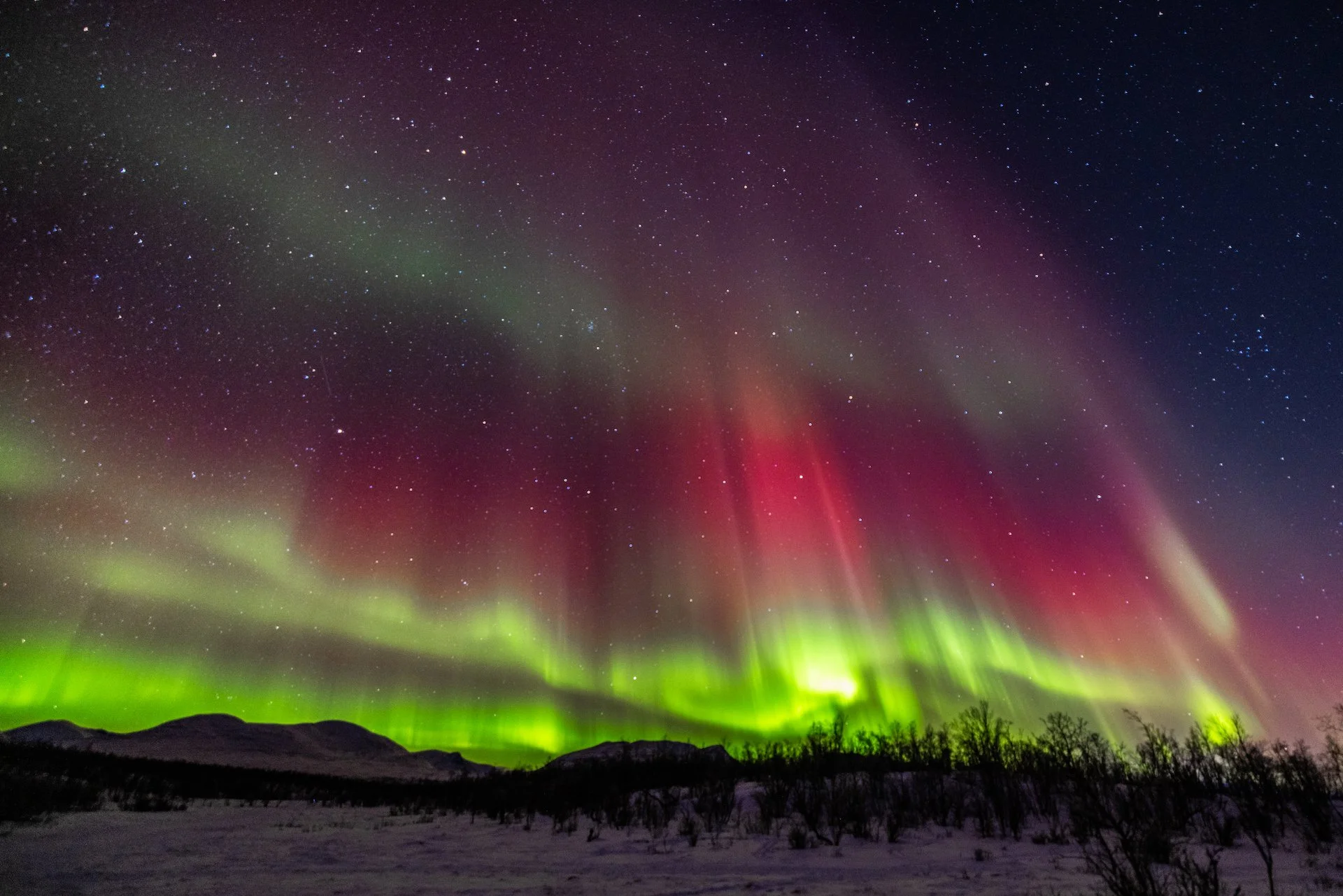
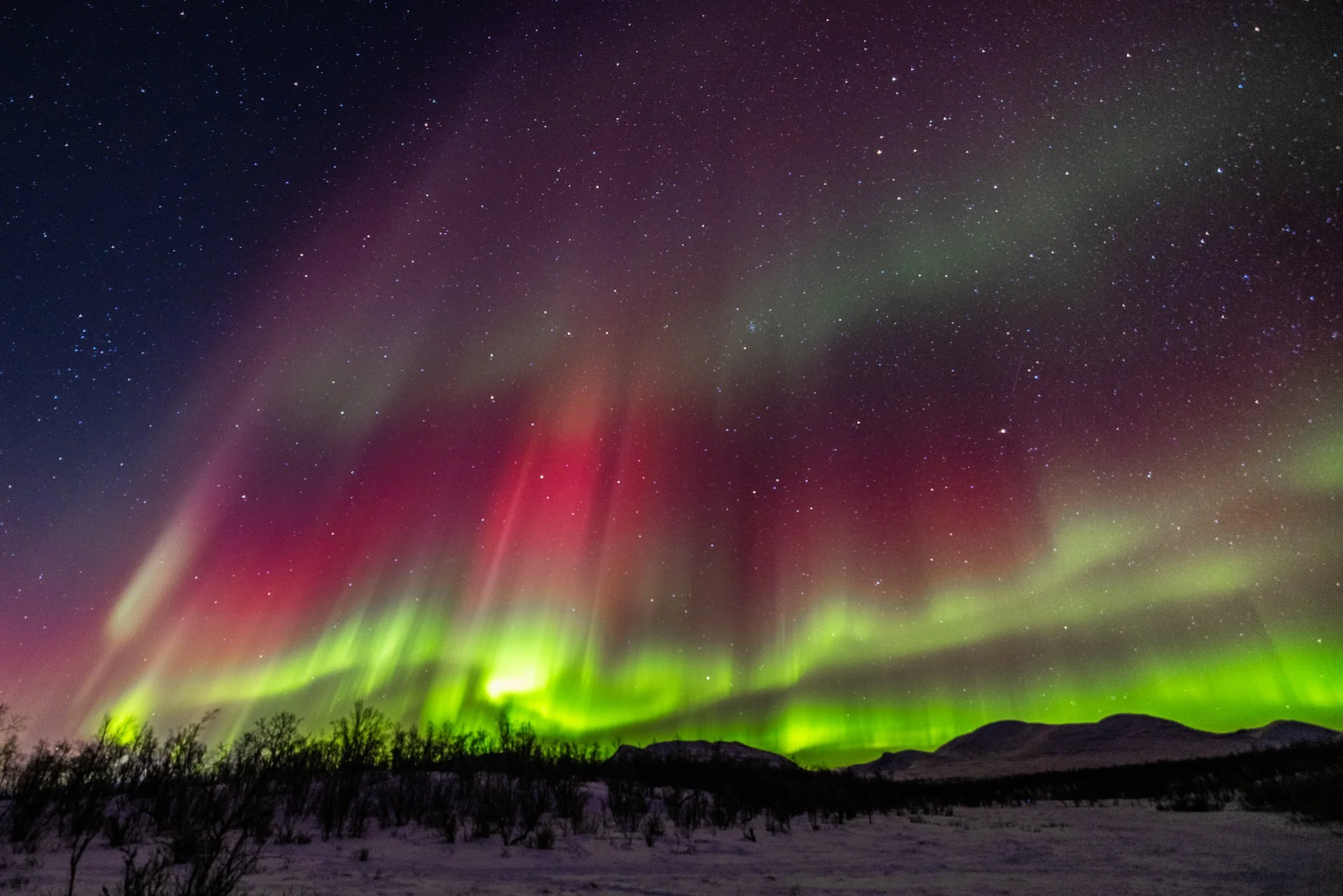
The color most commonly seen in the Northern Lights is green. It is produced when oxygen atoms in our atmosphere are excited by high-energy particles from the solar wind. This is the glow that most people associate with auroras.
Purple and pink tones are mainly caused by nitrogen. However, for these colors to become clearly visible, the aurora usually needs to be more intense and active.
Red Northern Lights are particularly rare. They are also caused by oxygen, but at much higher altitudes—often above 200 kilometers. Because the conditions required for red auroras are relatively uncommon, they are among the most spectacular phenomena you can witness in the night sky.
During the five years I lived in the north, I was able to clearly see red Northern Lights with the naked eye only three times. That is exactly why those nights remain some of my most unforgettable aurora experiences.
Why Can’t I See the Colors of the Northern Lights?
There can be several reasons for this.
People differ in how well they perceive colors in low light conditions. Some can already see distinct green tones in faint auroras, while others describe the same display as a gray or whitish glow. Interestingly, children often seem to be the first to notice colors in the Northern Lights. In general, however, human color perception decreases significantly in darkness.
You can easily test this yourself. Look around outside at night. Most of the time, it becomes difficult to distinguish the colors of jackets, hats, or other objects. In low light, our eyes are primarily designed to detect brightness and movement—not precise colors.
Interestingly, the human eye has a particularly high sensitivity to green wavelengths of light. This is one of the reasons why green is the color most commonly and clearly seen in the Northern Lights.
Even so, auroras almost never look the way they do in photographs. Even during very strong displays, the green usually appears much softer and more natural than many people expect. It resembles a gentle glow in the sky rather than a bright neon light.
If you want to see as many colors as possible, you should avoid artificial light sources. Move away from streetlights, building lights, and car headlights. Even the bright screen of your smartphone can make it harder to observe the aurora properly.
Our eyes need time to fully adapt to darkness. Every glance at a bright screen resets this adaptation. That is why it is worth putting your phone away for a while and giving your eyes time to adjust.
Some of my most memorable aurora experiences happened exactly in those moments when I stopped focusing on the camera and simply looked up at the sky.
What Was Your Most Beautiful Northern Lights Experience?
If you asked me what my strongest Northern Lights display was and what my most beautiful experience was, I would have to give two different answers.
My strongest aurora occurred in March 2024. Together with a colleague, I was guiding a larger group of guests at the time. Throughout the entire night, the Northern Lights danced overhead in green, red, and violet. It was one of those rare events where you are not quite sure whether to take photos, simply watch in awe, or just try to absorb the moment. I also recorded a timelapse video from that night, which you can find here.
My most beautiful Northern Lights experience, however, happened only last winter.
After work, a few colleagues and I went ice skating on the frozen Torneträsk. The lake had turned into a vast, mirror-like sheet of ice. As we glided across its surface, the Northern Lights danced above us, while beneath our feet the ice sang and cracked.
The aurora reflected in the ice so clearly that it felt as if we were floating between two skies. It almost felt like flying. Was it the strongest aurora I have ever seen? No, definitely not. But it was one of those moments shared with friends that you never forget.
And that is the message I want to leave you with:
The most beautiful Northern Lights are not always the most intense ones. It is not about seeing the strongest geomagnetic storm of the year or capturing the perfect photograph. What truly matters is what you make of the moment.
Years later, you will probably not remember whether the KP index was 3 or 8. But you will always remember how it felt to see the Northern Lights for the very first time.
Northern Lights at a Glance – The 10 Key Takeaways
You can see the Northern Lights with the naked eye, but they usually appear less intense than in photos.
Your best chance of seeing auroras is between 60° and 75° latitude.
Clear skies are more important than a high KP index. Without a clear sky, there are no Northern Lights.
Forecasts are only reliable a few days in advance. The most accurate data comes from satellites measuring the solar wind.
Northern Lights can be visible in the early afternoon or only after midnight—darkness is the key factor.
The most common aurora color is green. Purple and red auroras are much rarer.
Auroras can stay calm and steady for hours or dance across the sky within seconds.
Cameras capture more light and color than the human eye, which is why auroras often look more spectacular in photos.
Artificial light sources and phone screens make it harder to perceive colors. The darker your surroundings, the better the experience.
Patience is part of aurora hunting. The most impressive moments cannot be planned—they simply happen.
Conclusion
The Northern Lights are one of the most fascinating natural phenomena on Earth. You can increase your chances of seeing them, but you can never guarantee when or how they will appear. That uncertainty is exactly what makes them so magical.
Those who travel to Lapland with realistic expectations, a bit of patience, and an eye for the moment will discover that the most beautiful auroras are often not the ones on Instagram—but the ones you experience yourself under a clear night sky.